

Our team will find the right solution for your requirements.
Case Studies | Power Supplies
Citel: "Active SPDs" Surge protective devices ensure the safe operation of systems and equipment

Frank Stocker
Field Application Engineer (FAE) Power Supplies
27.11.2025
Transient overvoltages are among the most common causes of failure of electronic devices in industry and building technology. This is where Citel surge protective devices provide an effective solution, reliably protecting systems and end devices from these stresses on both the power (mains) and data-line levels.
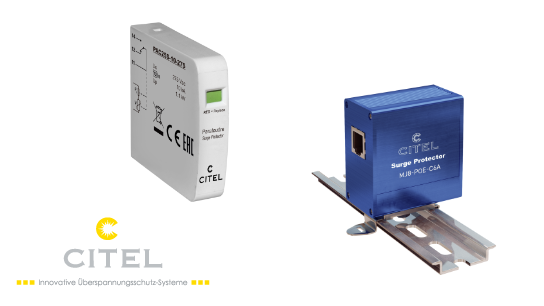
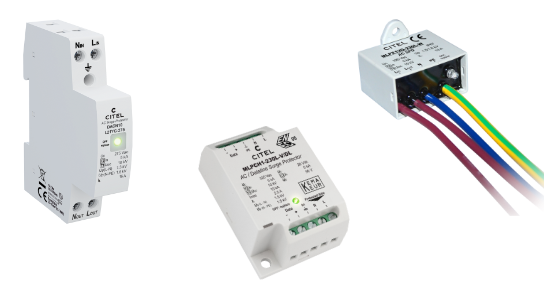
Figure 1: Different SPD designs for DIN-rail mounting, device installation, and PCB mounting. (Source: Citel)
Why are overvoltages a growing risk?
Modern industrial plants and building technology contain more and more sensitive electronics. As complexity and networking increase, the hazards posed by transient overvoltages rise significantly as well. Unexpected voltage spikes on power or data lines—caused, for example, by switching operations of inductive loads such as motors or by lightning strikes—jeopardize both data integrity and reliability. Even minor overvoltages can damage unprotected equipment or lead to costly downtime.
What are the biggest challenges in protecting electronic equipment?
Electronic systems—and the AC/DC switch-mode power supplies typically installed in them—are only protected to a limited extent against short-term overvoltages in accordance with the applicable EMC standards. Pulse energies above the protection level of the power supplies, and especially recurring pulses (even if smaller), often exceed the available protection margins. The varistors integrated as protective components in the AC input circuit of the power supplies are stressed by overvoltages, age prematurely, and therefore offer only limited protection against recurring overvoltages. Data interfaces are even more vulnerable by comparison. Up to 50% of premature failures in switch-mode power supplies are attributable to overvoltages. Particularly in industrial applications—with frequent switching of larger loads or operation under harsh conditions such as outdoor use—there is a risk of undetected pre-damage or functional failures.
How do active SPDs effectively safeguard system operation?
Active surge protective devices (SPDs) are an essential complement to the protection built into power supplies. They limit overvoltage impulses before they can reach critical components. Decisive factors include a low protection level of below 1,500 V, high energy absorption, and the fast response time of modern SPDs. It is not only the maximum voltage amplitude that matters, but above all the energy of the disturbance pulse that the device can absorb and safely divert. This energy depends on both the pulse duration and the pulse waveform. High-quality SPDs respond within a few nanoseconds, conduct the surge current in a controlled manner to earth/ground, and thus limit the voltage at the end device to a level that is safe for electronic components. Thanks to their targeted design—using gas-filled spark gaps, varistor blocks, and a thermal disconnect device—functionality and protective performance are maintained long-term even under repeated overvoltage events. This not only prevents immediate destruction of electronic assemblies but also significantly extends their service life. If the SPD itself is overloaded, an integrated mechanism disconnects the device automatically and signals the need for maintenance. This keeps systems and infrastructure protected.
Which types of surge protection are used when?
A tailored protection concept combines different SPD types matched to the specific installation environment:
- Type 1: Lightning current arresters for the main distribution board
- Type 2 / 2+3: Protection against switching overvoltages and induced disturbances, for installation in distribution boards or directly at the end device
- Type 3: Device-level or fine protection directly at the end device, provided SPDs are installed in the sub-distribution board
- Combined variants (1+2+3): Comprehensive protection for complex systems
Solutions are available for DIN-rail mounting, chassis installation, or as modules for PCB mounting. They are ideal for industry, infrastructure, and compact electronic systems.
How can existing installations be protected sustainably?
Even if surge protection is already present in the main distribution board, long cable runs or disturbances within the building can create new risks. Retrofitting an SPD directly at the end device provides targeted, sustainable protection against consequential damage, extends the service life of electronics, and reduces maintenance costs. This investment is particularly worthwhile for system-critical components, outdoor installations, or hard-to-access parts of a system.
About us
As a power supply distributor we stock power supplies from various manufacturers such as Citel, MEAN WELL, Recom, and others. We keep around 8,000 different types of power supplies in stock in production-ready quantities at our automated central warehouse in Monheim am Rhein. As a reliable supplier we also offer fast and competent support, for example through direct contact persons and a field service for on-site problem solving. Our customers benefit from the rapid processing of their enquiries, the provision of data sheets and samples, and different delivery quantities from samples to series production.
Quick Links
More Case Studies

Case Studies | Power Supplies
MEAN WELL: Redundant power supply for maximum system reliability
27.11.2025 I With increasing automation and growing technical complexity, the demands on the reliability of power supply systems are rising. Particularly in safety-critical environments, a power failure can cause serious follow-up costs or ...

Case Studies | Power Supplies
Tridonic: LED drivers as building blocks for sustainable and connected lighting systems
25.09.2025 I With lumDATA, LED drivers open up new possibilities for smart lighting and digital building technology. They provide standardized data on identification, energy consumption, and diagnostics, forming the basis for ...

Case Studies | Power Supplies
RECOM: Mastering Peak Loads with Reliable Power Supply for Dynamic Loads
28.08.2025 I Industrial applications are increasingly characterized by dynamic load profiles consisting of typical loads, maximum loads, and short peak loads. Traditional power supplies quickly reach their limits in ...
Case Studies | Power Supplies
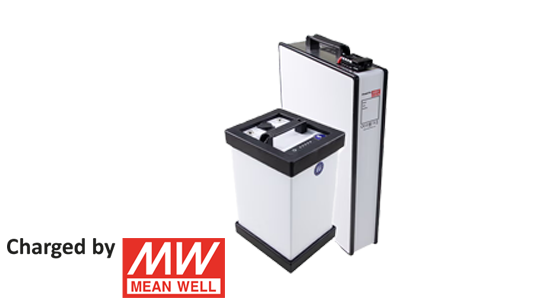
Perfect Synergy for Maximum Performance
24.07.2025 I Rechargeable lithium batteries for industrial applications place the highest demands on charging electronics. To ensure maximum availability, safety, and service life of battery systems, it is essential that the battery and charger are perfectly matched. This is exactly what manufacturer MEAN WELL...

