
MEAN WELL: Perfect synergy between battery and charger for maximum performance
Coordinated Battery and Charging Technology as the Key to Efficiency in Industry and E-Mobility
Power Supplies I 24.07.2025
Rechargeable lithium batteries for industrial applications place the highest demands on charging electronics. To ensure maximum availability, safety, and service life of battery systems, it is essential that the battery and charger are perfectly matched. This is exactly what manufacturer MEAN WELL focuses on. In addition to its broad portfolio of battery chargers, the company also offers its own high-quality lithium batteries with the FMB and QHB series.
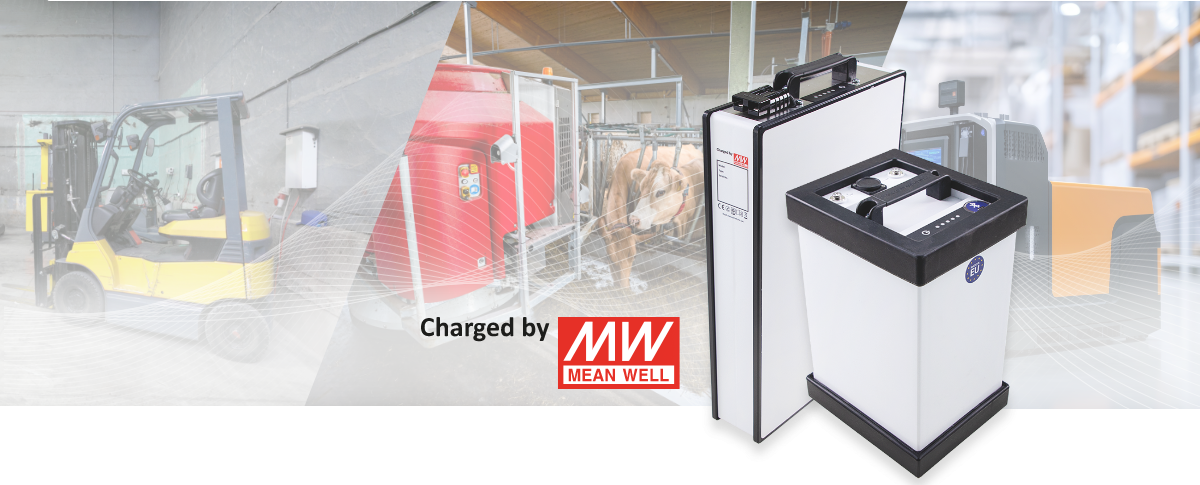
Figure 1: The FMB and QHB battery series are characterized by their intelligent, flexible, and safe charging electronics, as well as their high capacities. Featuring a modular design, digital interface, robust construction, and IP67-rated variants for demanding operating conditions, they qualify as a universal solution for a wide range of battery applications – from industrial systems to e-mobility. (Source: MEAN WELL)
Which types of lithium batteries are used and why do they require specialized chargers?
The use of lithium batteries has significantly increased in recent years – from portable devices and mobile machinery to stationary energy storage systems. What all these applications have in common is the need for a safe and intelligent charger tailored to the specific cell chemistry. Among the various lithium-ion chemistries, two variants are particularly widespread and also used by MEAN WELL in its own battery series: NMC (Nickel Manganese Cobalt) and LFP (short for LiFePO₄, Lithium Iron Phosphate). Each type has specific properties that make it well suited for different use cases – from industrial applications and consumer electronics to electric mobility and stationary storage systems.
NMC cells offer high energy density combined with a good cost-performance ratio.
They are available in prismatic or cylindrical formats (such as the popular 18650 cells). LiFePO₄ cells, on the other hand, score points with longer service life and greater thermal stability. Their trade-off lies in lower energy density and lower cell voltage. To achieve the same system voltage, more cells are required, resulting in increased size and weight.
Unlike lead-acid or NiMH (Nickel Metal Hydride) batteries, lithium cells have very narrow voltage tolerances and are highly sensitive to overcharging or deep discharge. As a result, specially designed chargers with precise voltage and current control and integrated safety features are essential.
What charging requirements arise from the different cell chemistries?
Depending on the cell chemistry, different cell voltages apply – for example, 3.6 V / 3.7 V for NMC and 3.2 V for LiFePO₄. A suitable charger must precisely match both the nominal voltage and the charging profile to the specific battery chemistry. Depending on the type, there can be significant differences in the final charging voltage, maximum charging current, and permissible temperature range.
Which factors truly matter when selecting and integrating the right lithium charger?
- Chemistry-Dependent Charging Parameters: The final charging voltage varies depending on the cell type. Chargers must precisely match the resulting system voltage based on the chemistry and the number of cells in series. Deviations can lead to cell damage, capacity loss, or thermal instability.
- Current and Power Sizing: The maximum allowable charging current depends on the battery type and its capacity (Ah). Manufacturer specifications must be strictly followed. Excessive charging currents can cause critical rises in cell temperature. The charging power should be dimensioned high enough for efficient operation - but without unnecessary oversizing.
- CC/CV Charging Profile: Lithium cells generally require a constant current / constant voltage (CC/CV) charging method with a smooth phase transition between stages.
- Communication Capabilities: Integrated interfaces that allow direct communication with an external controller or the connected battery enable maximum control, optimized lifetime, and enhanced system performance.
Why is it beneficial to use batteries with an integrated BMS?
A Battery Management System (BMS) is an electronic circuit integrated into the battery that monitors and controls the charging parameters, performance, and safety of lithium-ion cells.
Key advantages of this feature:
- Prevents overcharging, deep discharge, and overheating
- Optimizes charge and discharge cycles, actively balances cell voltages, and maximizes overall performance and service life
- Enables monitoring, diagnostics, and status reporting via an optionally integrated communication interface
How do MEAN WELL batteries and chargers enable flexible, safe, and smart energy integration?
With its FMB and QHB series, MEAN WELL offers LiFePO₄ and NMC batteries equipped with an integrated Battery Management System (BMS). With capacities of up to 70 Ah and the option to connect multiple batteries in parallel, these series provide ideal solutions for indoor and outdoor applications (thanks to IP67 protection) where high capacity is essential. Complementing this, MEAN WELL offers a wide range of programmable chargers with various power levels that can be configured to match the charging profiles of different battery types.
The latest generation of MEAN WELL chargers - especially the NPB and RPB series - alongside the FMB and QHB battery lines, are designed for easy integration into IoT and smart grid environments. Through digital interfaces such as CAN bus or Wireless Connection, charging parameters can be monitored and adjusted, and the state of charge can be tracked in real time. This enables remote monitoring, predictive maintenance, and intelligent energy management - a crucial advantage for industrial applications, fleet management, and stationary energy storage solutions.
Table 1: Recommended Charger Selection Based on Battery Capacity, Quantity, and Interface of the MEAN WELL Battery
| MEAN WELL Charger (1 piece each) | MEAN WELL Lithium Battery | |||
NPB-450-48 or NPM-750-48 | 1 pc FMB-48N33.8(C)/FMB-48N43.5(C) | |||
| NPB-1200-48 |
| |||
|
| |||
|
| |||
| RPB-1600-48CAN | 5 pcs FMB-48N33.8C or FMB-48N43.5C |
What difference does precise matching between battery and charger make in real-world use?
By precisely matching the chargers to the respective lithium batteries, their performance can be maximized and their service life significantly extended. The use of MEAN WELL chargers in combination with FMB and QHB battery series, including their integrated BMS, ensures a highly stable and safe power supply - both for stationary and mobile applications.